
2025–26 FIS Cross-Country World Cup Schedule — The Road to Lake Placid
Every winter our household quietly shifts into “World Cup mode.”
Phones get checked before sunrise, and before we even clip into our own skis, the best athletes on the planet are already done racing somewhere across the Atlantic.
The 2025–26 FIS Cross-Country World Cup season promises to be one of the most meaningful seasons in years. Between the regular World Cups, the Tour de Ski, and the Olympic Winter Games Milano-Cortina 2026, a remarkable 72 elite international races will be contested this winter. We follow the action through live streams and replays on Skiandsnowboard.live, which lets us follow the action from home, a ski lodge, or occasionally inside Wolfie with sleepy kids in the back — and sometimes the girls even watch race replays during long drives to our own ski adventures when Lukas is driving, which somehow makes the road feel shorter and the upcoming ski day even more exciting.
Winter’s ultimate endurance athletes return to snow in late November, and the storylines begin immediately.
A Season of Records
The center of attention remains Johannes Høsflot Klæbo. After winning six gold medals in six events at the Trondheim World Championships, along with five Olympic gold medals, five overall World Cup titles, and 98 career World Cup victories, he has already secured his legacy as the greatest cross-country skier ever. This winter could elevate him even further. A few more victories would make him the first man to reach 100 World Cup wins, and a sixth Crystal Globe would tie him with the legendary Bjørn Dæhlie.
Norway, as always, brings depth behind him. Erik Valnes continues to be a sprint threat, and Harald Østberg Amundsen will try to reclaim the overall title during an Olympic year, alongside fellow contenders such as Martin Löwström Nyenget. Outside Norway, Sweden’s rising star Edvin Anger is growing into a major contender, while Italy’s Federico Pellegrino enters what could be his final Olympic cycle still searching for Olympic gold.
The opening half of the season carries unusual importance because World Cup points earned before February help determine Olympic qualification for Milano-Cortina 2026. Athletes must balance racing and training carefully — some will chase results immediately, others will prepare quietly in the background. Either way, every early race matters.
From Ruka to the Tour de Ski
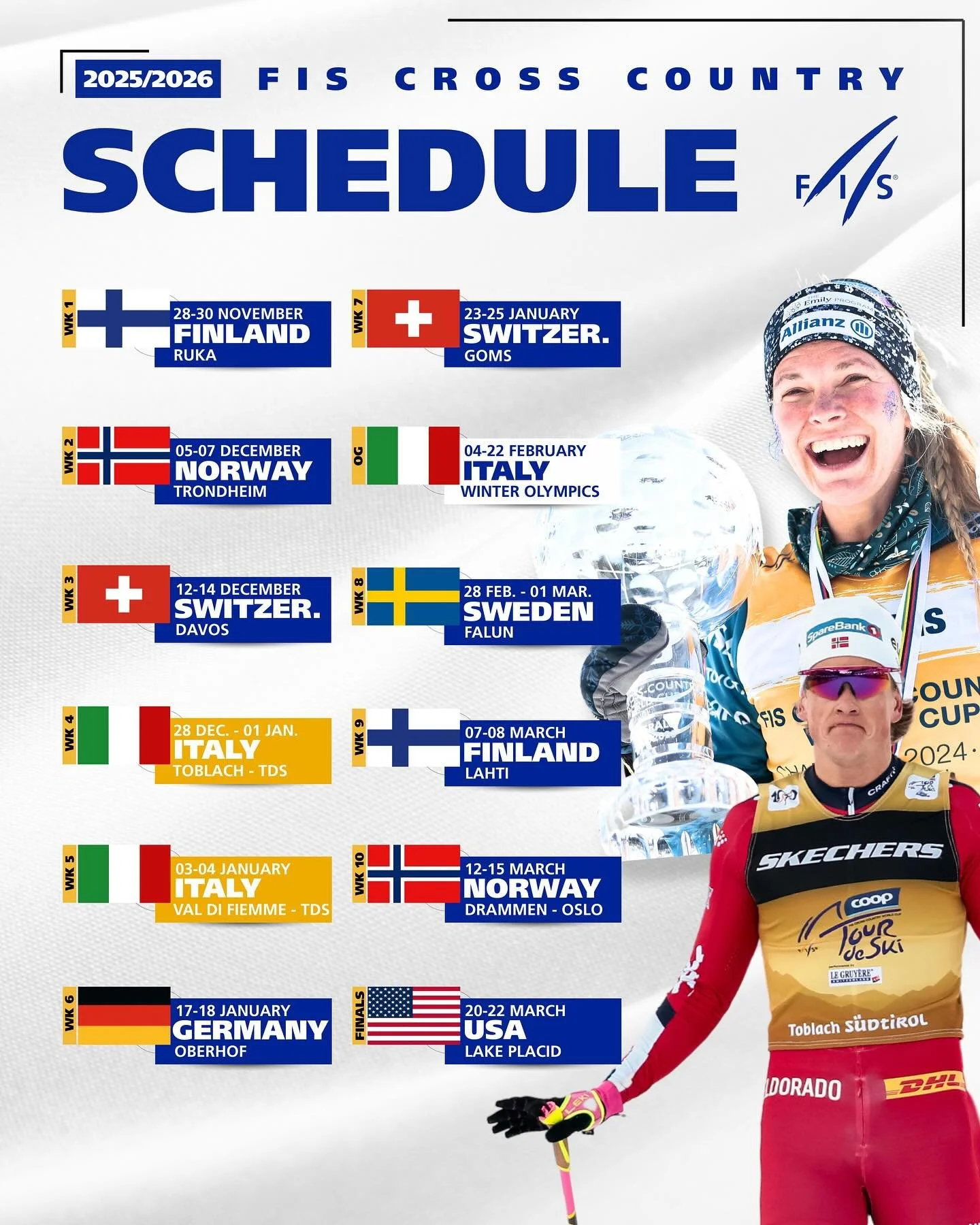
The season begins November 28 in Ruka, Finland — the traditional opener known for cold temperatures, dark skies, and a brutally honest test of early fitness. From there the World Cup moves through Scandinavia and Central Europe before reaching the Tour de Ski over the New Year in Toblach and Val di Fiemme. The Tour, now in its 20th edition, remains one of endurance sport’s toughest challenges, culminating in the famous Alpe Cermis climb where athletes ski straight up a ski hill to the finish. If you have kids learning to ski, it’s a surprisingly inspiring race to watch together. Suddenly uphill skiing complaints take on a very different perspective.
The winter then transitions toward the Olympic Games in February. Because of the Olympics, the World Cup season feels different: athletes must time their peak form carefully, and results will fluctuate more than usual.
The World Cup Comes Back to the United States
The most exciting part of the schedule for North American fans comes at the very end.
The season concludes in Lake Placid, New York, in March 2026 — the only non-European stop of the year.
After the incredible atmosphere of the Minneapolis World Cup in 2024, the return of the sport’s highest level to the United States feels significant. World Cups in America are rare; World Cup Finals in America are even rarer. Lake Placid is not just another venue. It is an Olympic town, home of the 1932 and 1980 Winter Games, and the Mt. Van Hoevenberg trails are among the best race courses on the continent.
For American fans it means something simple but powerful: you can finally watch the world’s best racers live without setting an alarm for the middle of the night. For young skiers, it means seeing heroes in person. And for the sport itself, it shows that cross-country skiing in North America is growing. Minneapolis proved the enthusiasm exists — Lake Placid confirms the World Cup is paying attention.
It genuinely feels like the World Cup is returning to the U.S., not just visiting.
Why We Follow the World Cup
Following the World Cup has become part of our family skiing routine. The kids recognize athletes, we talk about race tactics over breakfast, and later on the trails someone always attempts a Klæbo-style double pole for a few seconds before laughing.
Watching elite skiing makes everyday skiing better. You start noticing technique, pacing, waxing conditions, and strategy. The sport becomes more connected — from your local Nordic center all the way to Olympic competition.
So keep that schedule image nearby this winter. Wake up early occasionally, watch a sprint together, and then go ski the same day.
By the time March arrives and the season finishes in Lake Placid, you won’t just have watched the World Cup — you’ll feel like you were part of it.